
Home battery storage that works around your daily electricity use.
Solar panels often produce most around midday, while many homes use more electricity later on. A battery keeps spare daytime generation for the evening, instead of sending it to the grid at a lower rate than you pay for evening imports. Solar and battery installations are also currently zero-rated for VAT, a relief that runs until 31 March 2027.
Free to enquire, nothing to commit to. Qualifying routes for finance.
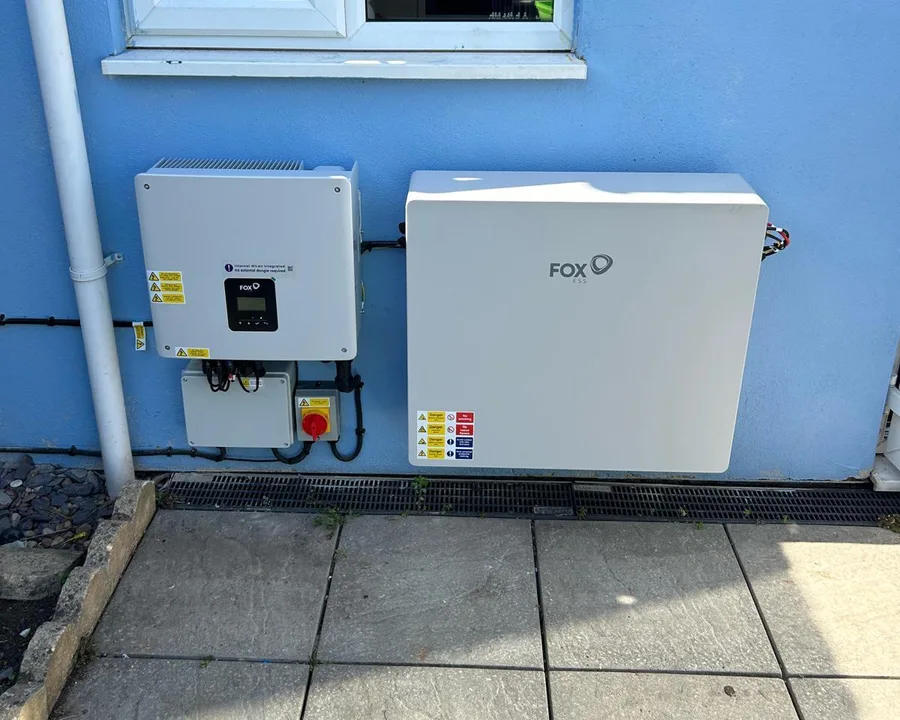 A home battery storage unit
One design, not two separate purchases.
Designed together, the inverter, battery and panels are specified as a single system, so spare generation is stored instead of going straight to the grid.
Panels already on the roof? A battery can normally be added without replacing the array, once we have checked the inverter and setup.
No solar yet? A battery can still be topped up from the grid overnight on a cheap tariff, taking care of the dearer hours. It does better alongside panels but can stand alone.
Array size and battery size are different questions.
More panels does not automatically mean a bigger battery. Among the Norfolk homes on this site, the largest array has a mid-size battery, and a 12-panel home has the biggest. Each was sized to the household, not to a table.
Every household is different. A family home can use 3,500 to 5,000 kWh in a year, and plenty draw 3 to 7 kWh between dusk and morning, the window a battery is there to cover. If someone is home all evening you will want more capacity than if everyone is out until six, which is why we size from your own usage.
Making your tariff work harder.
Many batteries also charge from the grid overnight on a cheap tariff and discharge when rates peak, and some can sell stored charge back through a Smart Export Guarantee tariff. Whether that pays hinges on your tariff, and we check it with you.
Power cuts, backup and equipment.
A battery does not automatically keep the lights on in an outage. It depends on the battery, the inverter and how it is wired, so raise it early if backup matters to you. Your proposal states what is included.
The batteries we can specify include Duracell, Fox ESS and Growatt, and on some jobs others such as Tesla Powerwall. App monitoring is standard on most modern units, so you can see what is stored and used.
Pay in one go or spread the cost.
With the design final, enquire about monthly payment plans and qualifying routes needing nothing upfront. Where options qualify, a battery can join the finance for a solar project, or be priced separately when it goes onto existing panels. Some selected products carry short-term 0% offers from time to time.
Finance is subject to status, affordability and lender approval. The installation team behind Norfolk Solar acts as a credit broker, not a lender. Asking about payment options is not a finance application and won't affect your credit file.
Battery questions, answered.
Is a battery worth adding?
That depends on when the household draws power. If most of it comes after the panels have stopped, a battery saves daytime generation that would otherwise be exported for a fraction of the price you pay to buy it back. We go through your pattern in the proposal.
How long does a home battery last?
Most home batteries come with cover for roughly a decade or a set count of charge cycles, whichever is reached first, and many carry on beyond it. The terms for your chosen model arrive with the proposal.
Where does the battery go?
Usually close to the consumer unit and inverter, so a garage, utility room or outside wall. Older cottages, barn conversions and newer estates all differ, so we settle the spot on site rather than assume a standard layout.
Pair the battery with the rest of the plan.
Solar Panels
Make the electricity the battery stores. See solar installation in Norfolk →
EV Charging
Stored daytime power, ready when the car goes on charge. Check EV charger options →
Check your roof
Let us know when the house is busiest for power and whether you have solar already. That gives us what we need to start sizing a battery.
Free to enquire, nothing to commit to. Qualifying routes for finance.
This commits you to nothing. Should the property suit a battery, expect a request for a few more details before anything is specified.